
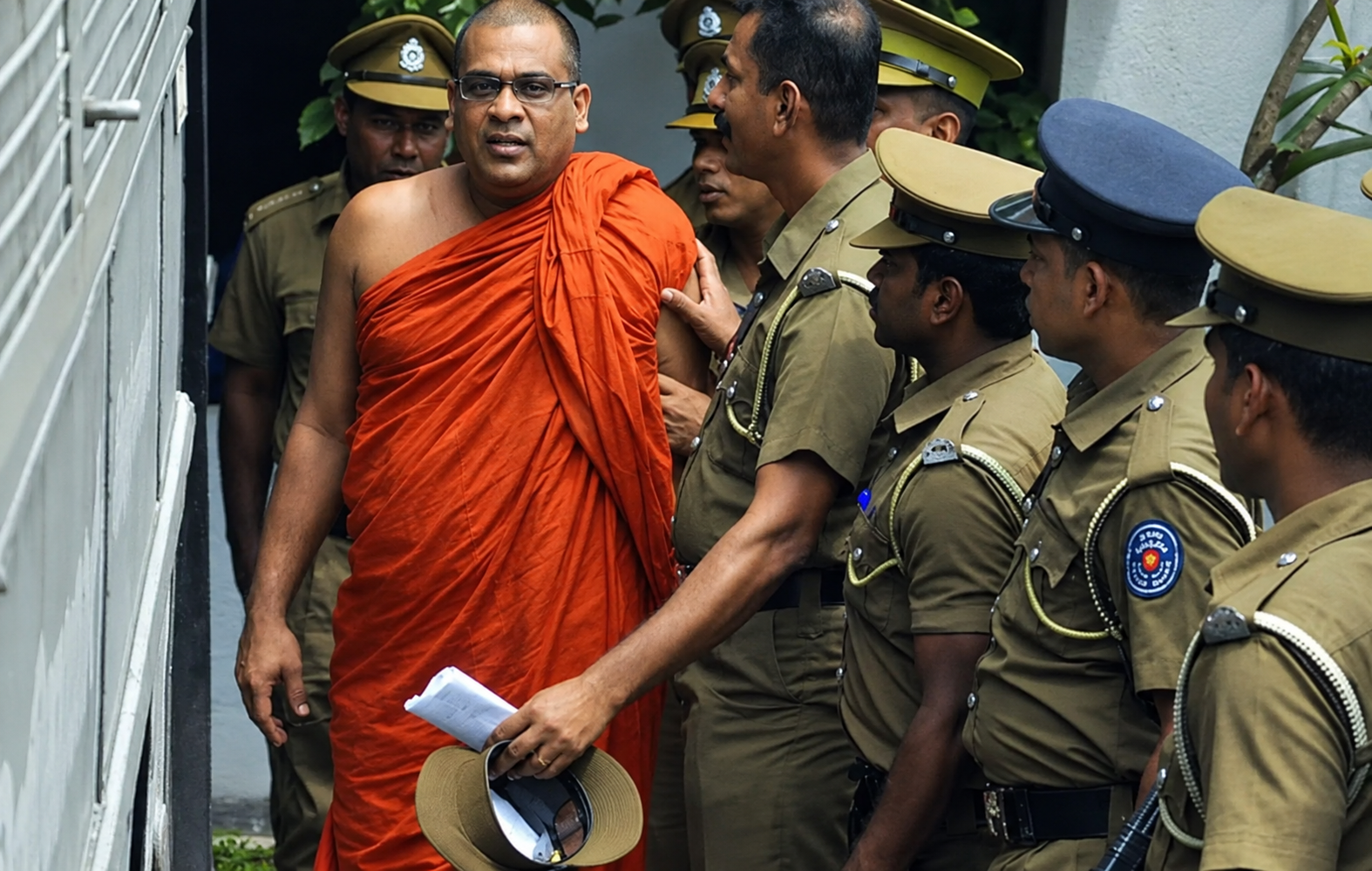
The Supreme Court today ruled that the Presidential pardon granted to controversial monk Ven. Galagoda Aththe Gnanasara Thera was invalid in law.
The pardon was granted to Gnanasara Thera by former President Maithripala Sirisena in 2019, following his sentencing to six years of rigorous imprisonment for contempt of court by the Court of Appeal in 2018.
The ruling follows the hearing of fundamental rights petitions filed in the Supreme Court by the Centre for Policy Alternatives (CPA) and Sandya Ekneligoda – the wife of missing journalist Prageeth Ekneligoda – challenging Sirisena’s decision to grant the pardon.
Background
In January 2016, Ven. Gnanasara Thero disrupted a Homagama Magistrate’s Court hearing on the disappearance of journalist Prageeth Ekneligoda, addressing the court without permission and threatening Sandya Ekneligoda.
He was subsequently charged with contempt of court, obstructing court proceedings and intimidating a public servant.
In May 2018, the Homagama Magistrate’s Court found him guilty of threatening Sandya Ekneligoda within the court premises and sentenced him to six months’ rigorous imprisonment.
In August 2018, the Court of Appeal convicted him on four counts of contempt of court over the same 2016 incident and sentenced him to 19 years’ rigorous imprisonment, to be completed concurrently within six years.
On 23 May 2019, former President Maithripala Sirisena granted Gnanasara Thero a presidential pardon, releasing him after about nine months in prison.
The move, widely criticised by civil society and legal groups, was seen as undermining judicial independence and sparked immediate calls for the pardon to be challenged in court.
Pardon
On 23 May 2019, former President Maithripala Sirisena granted Gnanasara Thera a presidential pardon, leading to his release after serving approximately nine months in prison.
The move was widely criticized by civil society and legal groups for undermining judicial independence and sparked immediate calls for the decision to be challenged in court.
The Centre for Policy Alternatives and Sandya Ekneligoda subsequently filed fundamental rights petitions in the Supreme Court challenging the lawfulness of the pardon.







Comments
Moderated before publishing. Your email stays private.