
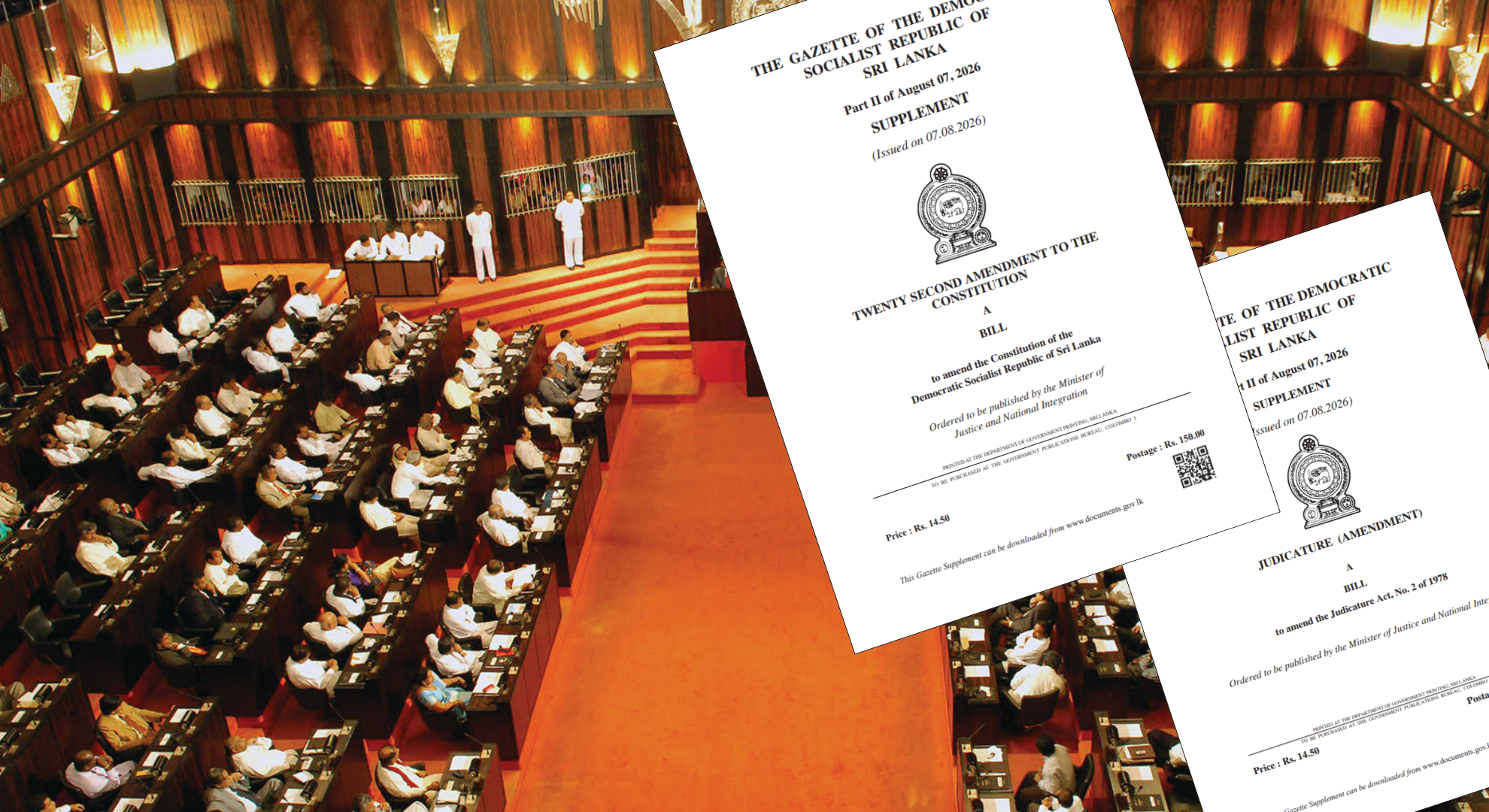
The government tabled the 22nd Amendment Bill to the Constitution in Parliament today, proposing an increase in the retirement age of Supreme Court and Court of Appeal judges.
The Bill also seeks to expand the number of Court of Appeal judges and introduces a six-year term limit alongside a retirement age of 67 for the Chief Justice.
Concurrently, the government tabled the Judicature Amendment Bill to raise the retirement age of lower court judges.
Background
The government argues that these amendments are essential to address the country's backlog of 1.1 million judicial cases.
By extending the service of seasoned judges, the administration maintains that case continuity can be preserved and the backlog cleared more efficiently.
However, critics -- including judicial bodies, legal professionals, and opposition parties -- have strongly opposed the measures, warning that altering retirement ages mid-tenure risks executive interference and damages judicial independence.
22nd Amendment
The 22nd Amendment Bill proposes raising retirement ages for Supreme Court judges from 65 to 67 and Court of Appeal judges from 63 to 65.
It also proposes expanding the Court of Appeal bench from 19 to 24 judges.
As a constitutional amendment, the Bill requires a two-thirds majority in Parliament, with the Supreme Court expected to determine whether a public referendum is required.
Judicature Amendment Bill
The Bill amending the Judicature Act proposes increasing the retirement age of High Court judges from 61 to 63.
It also seeks to raise the maximum number of High Court judges from 110 to 120.
Additionally, the Bill seeks to raise the retirement age for all other judges and magistrates to 62, overriding the provisions of the Public and Judicial Officers (Retirement) Ordinance.
What next?
The Bill has now been referred to the Sectoral Oversight Committee on Governance, Justice and Civil Protection following its First Reading.
Any party wishing to challenge the Bill's constitutionality has 14 days from its presentation to file a petition before the Supreme Court.
If petitions are filed, the Supreme Court must review the challenges and communicate its official determination to the Speaker within 21 days.
















Comments
Moderated before publishing. Your email stays private.