
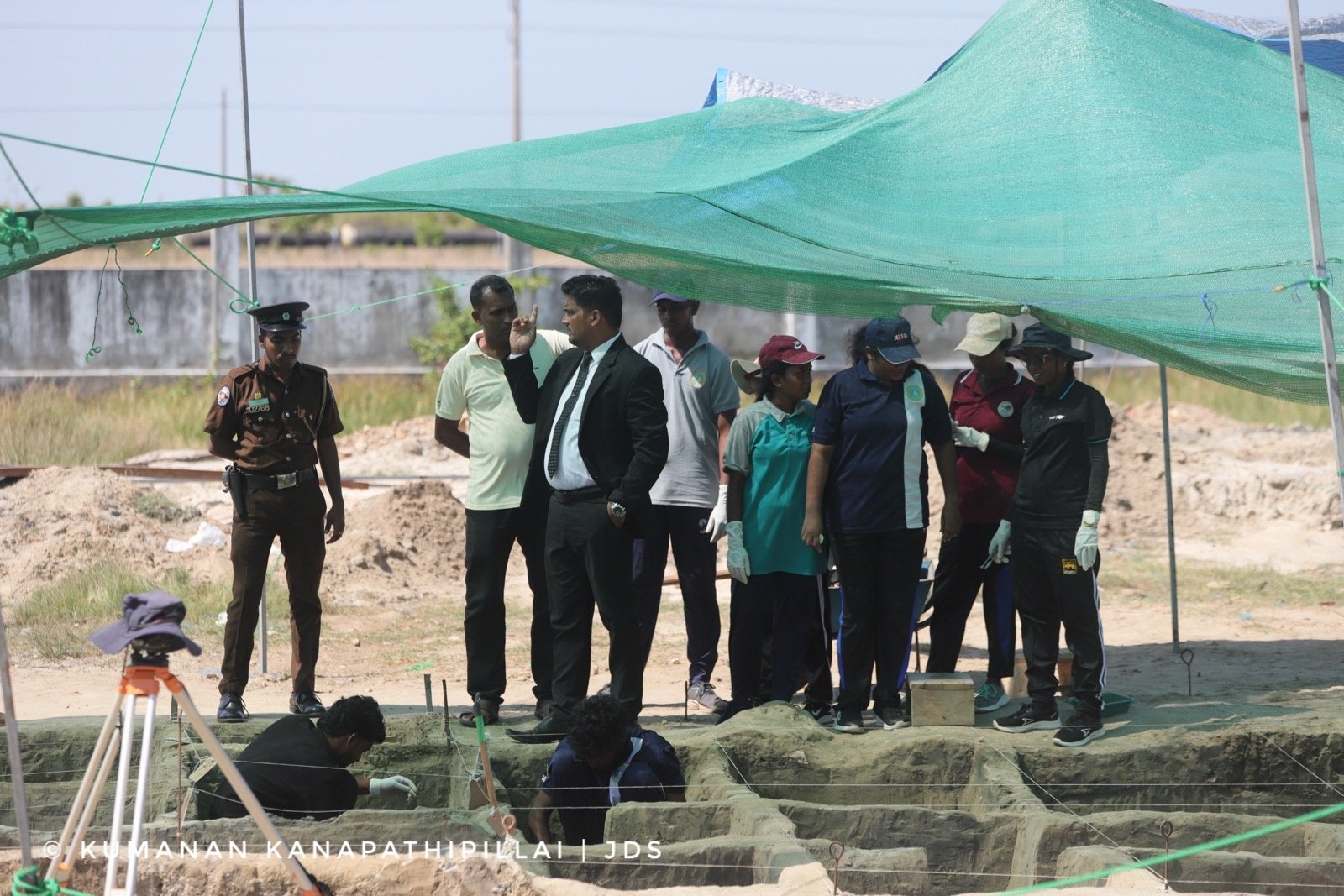
Forensic teams carrying out excavations at the Chemmani mass grave site in Jaffna reported the discovery of another 14 skeletal remains on Wednesday (June 14).
With this discovery the total number of human skeletons identified has increased to 380, which activists said made it the largest known mass grave site discovered in the country.
The excavations are led by Archeologists Professor Raj Somadeva and Judicial Medical Officer Dr. Sellaiah Piranavan, acting on a court order issued in May last year (2025).
Context
The existence of the grave site was first revealed during the 1998 trial of a Lance Corporal of the Sri Lankan Army, who was on trial for the rape and murder of a Tamil schoolgirl.
This period marked the height of the civil war offensives in the Jaffna Peninsula, during which hundreds of Tamil civilians were reported to have gone missing.
The Lance Corporal’s revelation in court, that the military secretly buried between 300 to 400 missing Tamils in shallow graves at Chemmani in 1996, led to an excavation mission at the site, under the watch of Amnesty International and Physicians for Human Rights.
Only 15 bodies were recovered at the time, two of whom were identified as missing Tamils.
Phase two
Fresh attention was drawn to the site in February last year, when construction workers clearing land for a crematorium at the Sinthupathy Cemetery accidentally struck human remains.
This led to a court-ordered excavation of the site in May 2025, led by Prof. Somadeva and Judicial Medical Officer Dr. Pranavan, with the number of identified skeletal remains rising to 240 by September that year.
Among the harrowing discoveries in the second phase of the excavation, were the remains of three neonatal infants under 10 months old, along with artifacts mixed into the dirt and bones, including children's toys, feeding bottles and a United Nations School bag.
In September, the Human Rights Commission of Sri Lanka (HRCSL) conducted a fact-finding mission and reported that there was sufficient evidence to rule a "reasonable likelihood" of unlawful extrajudicial killings.
Later that month, the excavations were suspended due to heavy monsoon rains and a delay in the release of funding from the Ministry of Justice.
Phase three
In April this year, the Jaffna Magistrate's Court ordered the resumption of excavation after an allocation of Rs. 2.1 million was released.
After 27 days in phase three of the excavations, the total number of identified skeletons rose to 380, making the Chemmani mass grave largest discovery and identification of human skeletons, surpassing the Mannar Sathosa mass grave where 376 human skeletons were identified.
Photo courtesy: Kumanan Kanapathipillai/Journalists for Democracy in Sri Lanka












Comments
Moderated before publishing. Your email stays private.