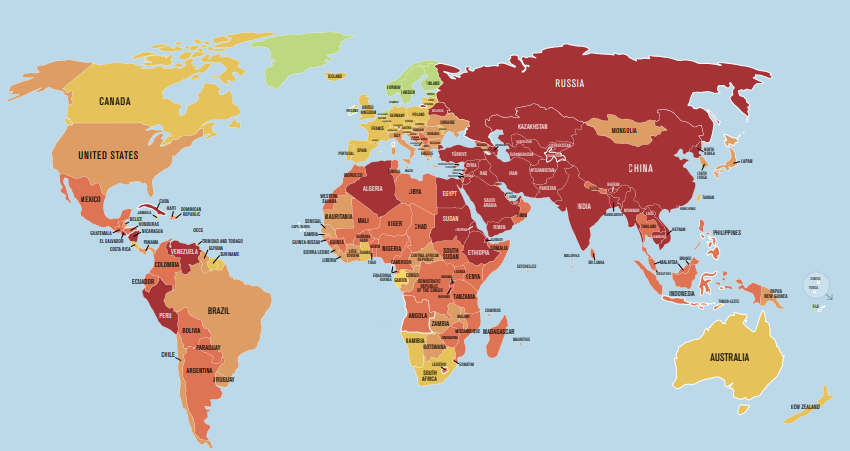
Press freedom in Sri Lanka has improved, the non‑governmental organization Reporters Without Borders (RSF) has said in its World Press Freedom Index 2026.
While it warned that press freedom in 100 out of 180 countries had declined, the index moved Sri Lanka up to 134th in its 2026 global ranking, up five places from 2025 – though conditions for the press are still considered ‘difficult’.
At the top of the ranking was Norway, which maintained its number one ranking from 2025.
Key takeaways
Releasing its 25th World Press Freedom Index, RSF said the overall average score of all the countries assessed has never been as low as in the 2026 index.
RSF also reported that in over half of the world’s countries and territories (52.2%), the state of press freedom was categorised as “difficult” or “very serious” – a figure that stood at 13.7% in 2002.
That same year (2002), 20% of the global population lived in a country where the state of press freedom was categorised as “good.” Twenty‑five years later, less than 1% of the world’s population lives in a country that falls under this category.
The United States fell seven places in the index, with other countries in the region, such as Ecuador and Peru also plummeting in their rankings.
The biggest improvement came from Syria, climbing 36 places from its 2025 ranking.
China, North Korea and Eritrea remain the three worst countries for press freedom.
Evaluation criteria
The World Press Freedom Index is built around a detailed questionnaire answered by local experts in each of the 180 countries and territories.
These experts typically include journalists, media professionals, lawyers working on media‑law issues, academics, and human‑rights or freedom‑of‑expression specialists, often selected by RSF and its partner organisations.
Their responses are kept confidential and anonymised to reduce pressure and ensure frank, consistent answers about the real environment for journalists on the ground.
The index has five contextual indicators as part of its evaluation criteria that reflect the press freedom situation in all of its complexity – political context, legal framework, economic context, sociocultural context and safety.
Each indicator is given a subsidiary score ranging from 0 to 100, with all subsidiary scores contributing equally to the global score.
All questions and sub‑questions within each indicator also have equal weight.










Comments
Moderated before publishing. Your email stays private.