
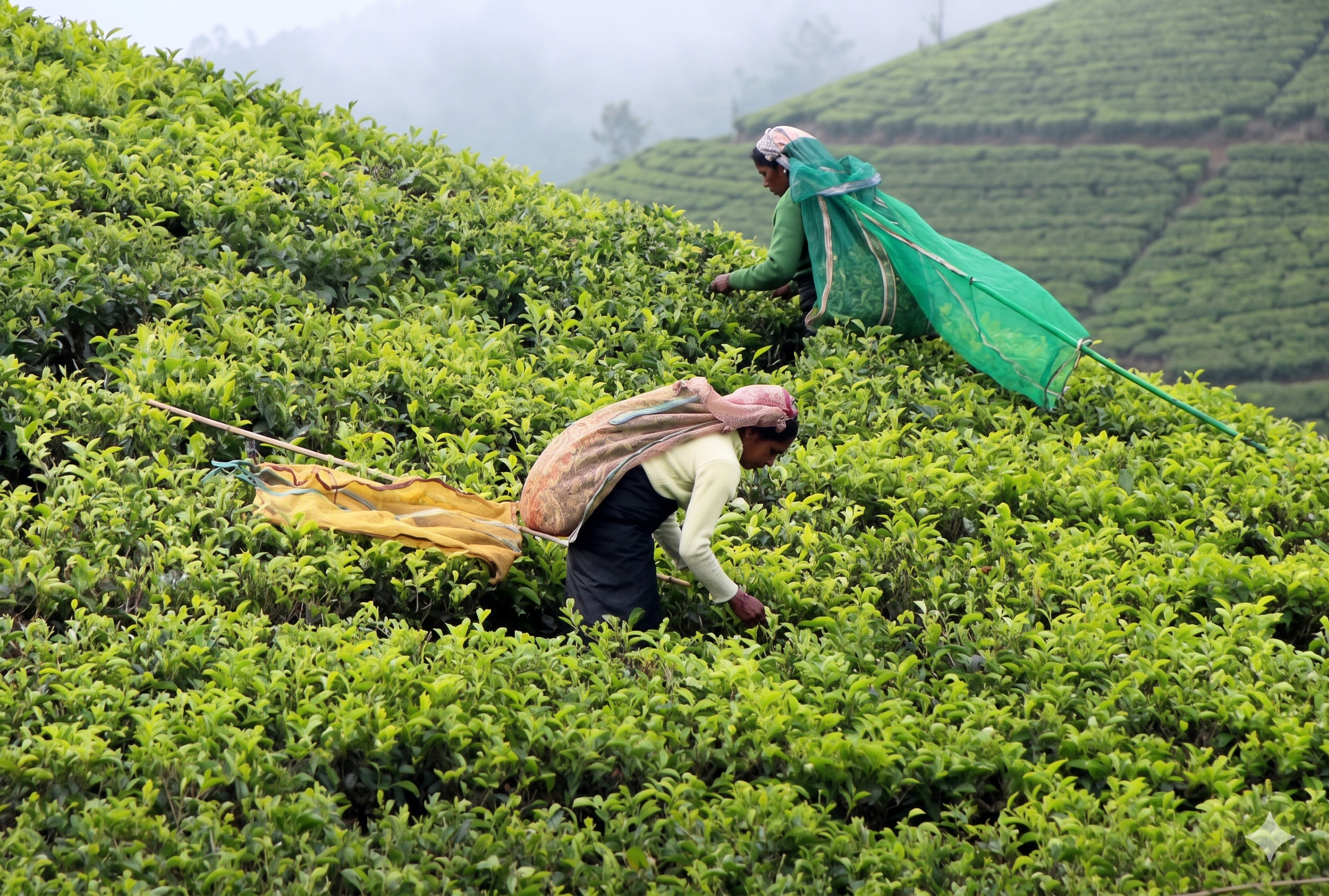
An Amnesty International report claims that private tea estates and smallholdings in Sri Lanka’s Southern Province have marginalised Malaiyaha Tamil workers by subjecting them to severe labour abuses that meet international indicators for forced labour.
The report detailed a harrowing pattern of systemic discrimination, physical violence, debt bondage, and restricted movement across 45 private estates in the Galle and Matara districts.
Among the many findings by the human rights organisation, employers are actively exploiting legal loopholes by misclassifying these historically marginalised plantation workers to deny them basic statutory protections, while the state fails to intervene.
Context
The report, titled ‘Abandoned by the State, Trapped in Private Estates’ and made public on Wednesday, was a result of a two-year investigation spanning from January 2024 to January 2026, Amnesty International, the global human rights advocacy group said.
Investigators interviewed 159 workers and held dozens of focus group discussions.
The report evaluates the practices of private estate owners against the International Labour Organization's (ILO) official indicators of forced labour.
Malaiyaha Tamils
Malaiyaha Tamils are descendants of workers brought to Sri Lanka from the southern part of India by British colonizers in the early 19th century to work on the island's tea plantations.
They continue to be a heavily marginalised and excluded community that has historically faced systemic and structural racial discrimination, making them uniquely vulnerable to labour exploitation, the report also said.
They remain entirely dependent on their plantation employers for their livelihoods, accommodation, and basic welfare, a power dynamic that leaves them unable to safely challenge poor living and working conditions, it also highlighted.
Physical Abuse and Unrealistic Targets
The report stated that workers on 15 estates had reported experiencing severe verbal and physical violence, including being beaten with sticks by managers for arriving late or inquiring about unpaid salaries.
Furthermore, investigators noted that management on 27 estates had enforced an unrealistic daily target of picking over 25 kilograms of tea leaves.
Amnesty International highlighted that failing to meet those quotas cut daily wages to just LKR 1,000 ($3.10), which forced workers into a permanent loop of high-interest loans and generational debt bondage.
The State's Failure of Regulatory Duty
The report charged that as an official member of the International Labour Organization (ILO), Sri Lanka was violating 44 international conventions, alongside UN treaties safeguarding human rights.
Investigators concluded that the state had almost completely abandoned its legal mandate to conduct independent labour inspections or enforce employment standards in the Galle and Matara districts.
The human rights group asserted that by failing to investigate reports of physical violence and wage theft, the government had effectively granted private estate owners total, legal impunity over their workforce.
Systemic Barriers to Legal Justice
Amnesty International pointed out that local police and state officials did not speak the workers' native Malaiyaha Tamil language, which created a massive barrier to reporting abuse.
Investigators also alleged that private estate owners intentionally withheld formal employment documentation, leaving workers with no legal proof to claim pensions or maternity benefits.
The report emphasised that trade unions were entirely absent or actively prohibited by employers, which left the community with zero organised representation to fight back.
Exploitation of Child Labour
The organisation stated that its two-year field investigation had documented instances of child labour, noting that investigators had interviewed children under the age of 18 who were working on the private estates.
The findings indicated that children were being pulled into the fields to help their parents meet the impossible 25kg daily quota, thereby sacrificing their education to avoid wage-docking.
Consequently, Amnesty International argued that the presence of minors working in hazardous agricultural conditions highlighted a total collapse of local child protection and compulsory education enforcement.
Restricted Movement and Inadequate Housing
The findings revealed that workers on at least 22 private estates faced strict, arbitrary restrictions on their freedom of movement, which required them to obtain managerial approval just to travel.
Additionally, the human rights organisation observed that families were being forced to live in overcrowded "line rooms" that completely lacked basic sanitation and sufficient living space.
The report further explained that because those workers owned no land, they lived in a constant state of fear and felt compelled to use submissive behaviour to avoid arbitrary, forced eviction by their employers.
Government Action
Despite the report highlighting the state’s inaction towards the issues faced by the Malaiyaha Tamil, the incumbent government brought in several measures to elevate the socio-economic standard of the plantation community.
Among them, was the finalising of a landmark agreement with regional operators to officially raise the daily plantation wage to LKR 1,750, executing a structured cost-sharing model where the state directly subsidises a portion of the payment.
The government also formally approved the historic 'Upcountry Charter' as an official policy roadmap, legally binding state infrastructure ministries to phase out colonial-era "line rooms" and replace them with modernised, dignified housing units equipped with localised childcare and health facilities.
A systemic distribution of thousands of permanent freehold title deeds under the national 'Himikama' land reform framework was also launched, effectively granting individual property ownership to plantation families to protect them from arbitrary estate evictions.
The government mobilised a multi-billion rupee allocation through the national budget specifically to establish centralised, state-funded medical clinics and childcare centres directly within the Southern Province smallholdings to bypass the historic institutional neglect by private owners.














Comments
Moderated before publishing. Your email stays private.