
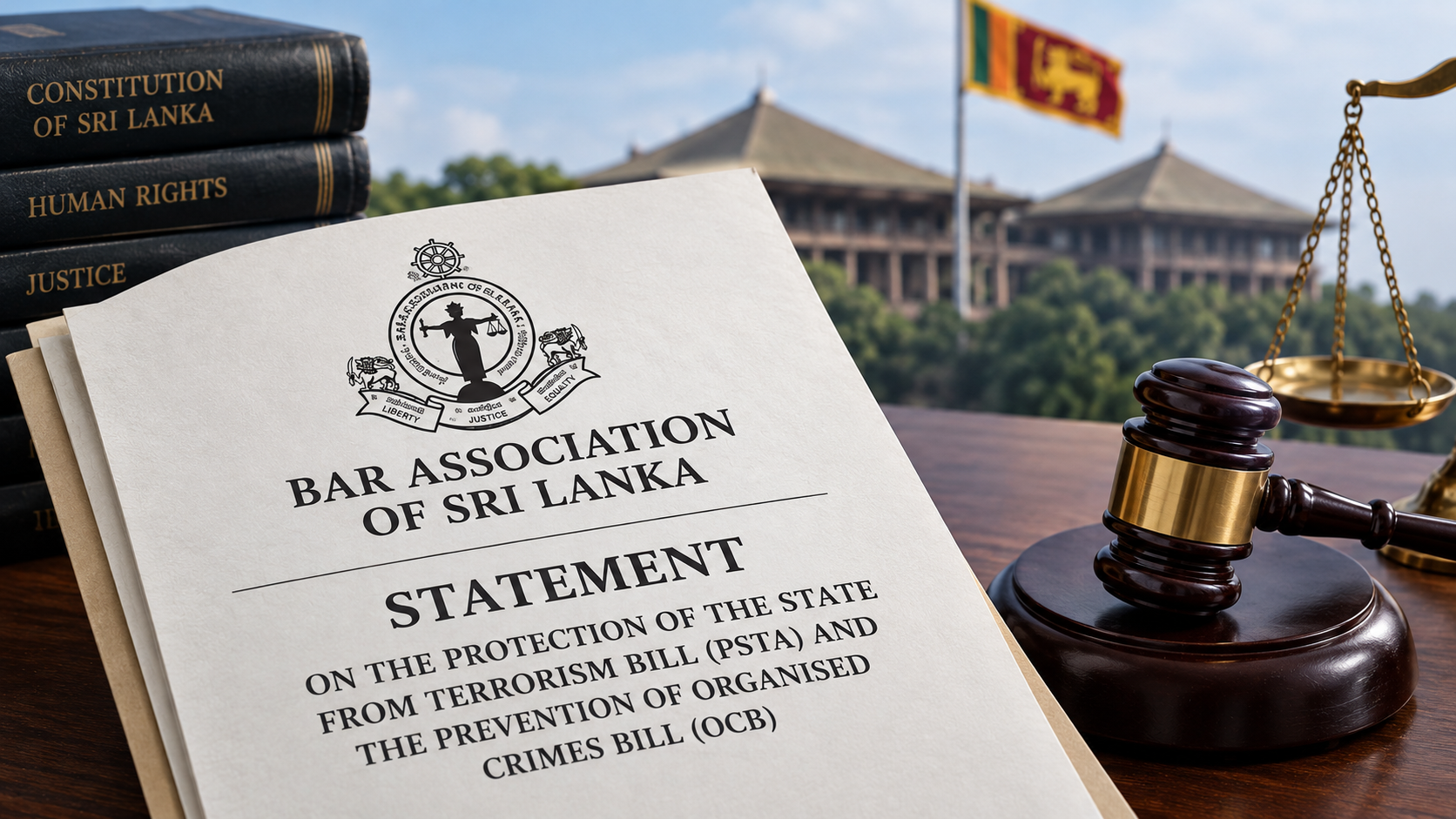
The Bar Association of Sri Lanka (BASL) has called for the government to withdraw the Protection of the State from Terrorism Bill (PSTA) and the Prevention of Organised Crimes Bill (OCB).
In a statement issued today, the association claimed that both draft legislatures confer extraordinary powers upon the Executive while significantly curtailing judicial oversight and individual liberty.
The BASL also alleged that while it participated in consultative committees for the PSTA, the final gazetted bill significantly deviated from the approved draft, without notifying review members.
Background
The Protection of the State from Terrorism Bill (PSTA) is a draft law that, if passed, would replace the decades-old Prevention of Terrorism Act (PTA), which has been criticised for arbitrary application and prolonged detention without trial.
The Prevention of Organised Crimes Bill (OCB) is stated to give effect to the UN Convention against Transnational Organised Crime and protect society from organised criminal groups.
Rights groups and legal professionals warn that both Bills contain broad definitions and executive detention powers without adequate judicial oversight.
BASL Demands
The BASL has called on the Government to withdraw the PSTA in its present form and restore the safeguards contained in the Committee-approved draft, including through amendments at the Committee Stage.
It also asked the Government to publish the Committee’s report and recorded dissent, and explain the basis for departures from that draft.
The BASL further called for the OCB to be withdrawn and subjected to full public consultation, and for the PTA to be repealed without delay.
Executive Overreach
The BASL says both Bills would confer extraordinary powers of arrest, detention, and surveillance on the Executive, while curtailing judicial oversight at stages critical to personal liberty.
It says the legislation creates broad criminal liability and expands executive powers, with far-reaching implications for freedom of association, expression, and movement.
The BASL warns that a democracy equipping its police and executive authorities with such powers risks drifting towards a police state.
Judicial Bypassing
According to the BASL, the gazetted PSTA requires a Magistrate to remand a suspect, significantly restricting the Magistrate’s discretion to assess whether remand is justified.
It says bail is available only through the High Court, and, for offences punishable by life imprisonment, only in exceptional circumstances.
The BASL notes that the Committee-approved requirement for Magistrate approval to extend detention beyond the initial two-month period was removed. Furthermore, the bill concentrates powers to proscribe organisations in the President and narrows safeguards protecting confidential legal advice.
Overbroad Scope
The BASL says the OCB classifies all offences punishable by four years or more, and approximately 50 scheduled offences—including copyright, excise, forest, and gambling-licensing offences—as “serious crimes”.
It says an “organised criminal group” is defined as a structured group of three or more persons acting in concert for a financial or material benefit, without requiring formal roles or continuity.
The BASL warns that a suspect could be held under Detention Orders issued by the Ministry Secretary for up to two months at a time and up to one year overall, without prior judicial decision or authorization.
Compromised Rights
The BASL says the OCB undermines fair-trial safeguards by allowing statements signed by an accused in police custody to be proved against that person.
It permits courts to infer group membership based on non-conduct traits like dress style, vocabulary, or tattoos, while explicitly denying those convicted eligibility for early release schemes.
It adds that corporate directors may be required to prove, on a balance of probabilities, that an offence was committed without their knowledge or that they exercised due diligence.
The BASL warns that these provisions could encompass peaceful protest, trade union activity, and civil society, creating severe risks for young people and marginalised communities.
Legal Challenge
The BASL has filed a Special Determination Application before the Supreme Court under Article 121 of the Constitution against the PSTA, arguing that its provisions violate fundamental rights.
It cites Article 4(d) read with Article 3, and Articles 10, 11, 12, 13, 14, and 14A, including freedoms of thought, speech, assembly, association, and movement.
The BASL also argues that the restrictions fail the permissible limitations on fundamental rights under Article 15 of the Constitution, while reserving its rights regarding a Supreme Court challenge against the OCB as well.












Comments
Moderated before publishing. Your email stays private.