
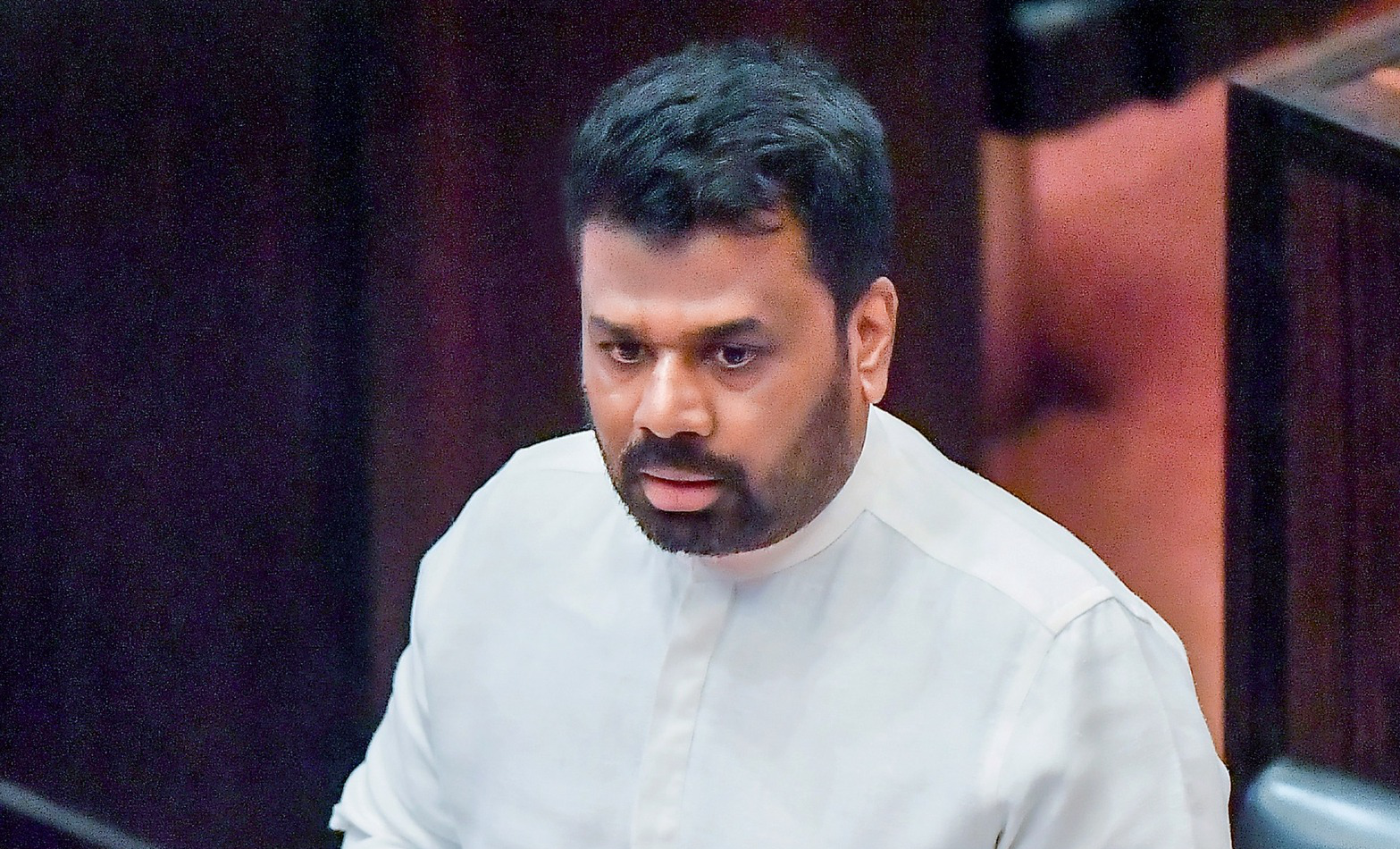
President Anura Kumara Dissanayake unveiled Sri Lanka’s Rs. 7.93 trillion budget for 2027, outlining a fiscal blueprint that combines personal income-tax relief and essential food-levy cuts with a sharp increase in public capital investment ahead of the scheduled conclusion of the country’s International Monetary Fund (IMF) programme in March 2027.
Presenting the proposals to Parliament in his capacity as Minister of Finance, Dissanayake projected total government revenue and grants at Rs. 6.18 trillion. Including a proposed Rs. 260 billion supplementary estimate for Cyclone Ditwah reconstruction, total expenditure stands at Rs. 7.93 trillion, leaving a budget deficit of Rs. 1.753 trillion, or 4.5 percent of GDP.
The Budget targets a primary surplus of 2.3 percent of GDP—equivalent to Rs. 890 billion—while raising public investment to Rs. 2 trillion, or 5.1 percent of GDP.
Personal Income-Tax Relief
To ease cost-of-living pressures on salaried earners, the annual personal income-tax-free allowance is proposed to rise from Rs. 1.8 million to Rs. 1.95 million effective April 1, 2027, lifting the monthly Pay-As-You-Earn (PAYE) tax-free threshold from Rs. 150,000 to Rs. 162,500.
The progressive income-tax structure will also be recalibrated across six brackets of 6 percent, 12 percent, 18 percent, 24 percent, 30 percent, and 36 percent. Under the revised bands, the 6 percent rate will apply to the first Rs. 850,000 of annual taxable income above the tax-free limit, followed by bands of Rs. 600,000 each taxed at 12 percent, 18 percent, 24 percent, and 30 percent.
As a result, the threshold at which the top 36 percent rate applies will rise from a monthly income of Rs. 358,000 to Rs. 433,000.
Cost-of-Living and Trade Adjustments
Immediate relief on selected staple imports takes effect from November 13, 2026, with the Special Commodity Levy (SCL) on imported Maldive fish slashed from Rs. 302 to Rs. 10 per kilogram and the levy on imported sprats cut from Rs. 100 to Rs. 10 per kilogram.
The SCL on powdered and unpowdered dried chillies is reduced by Rs. 50 per kilogram. Conversely, the SCL on imported sugar is proposed to rise by Rs. 10 per kilogram to narrow the tax disparity with domestically produced sugar.
While the headline 18 percent Value Added Tax (VAT) rate remains unchanged, textbooks, dictionaries, encyclopaedias, children’s drawing and colouring books, educational publications, other printed books, and exercise books are proposed to be exempt from VAT.
On the trade front, a 25 percent reduction in CESS rates across 800 selected Harmonized System (HS) code lines will take effect from April 2027, while the Ports and Airports Development Levy (PAL) on imported newsprint and solar-energy storage batteries will be removed from January 1, 2027.
Public-Sector Pay and Allowances
The Budget allocates Rs. 110 billion to execute the third and final phase of the multi-year public-sector salary restructuring from January 1, 2027, alongside targeted allowance revisions across key services.
Medical officers will receive a Rs. 25,000 monthly increase in their Disturbance, Availability, and Transport (DAT) allowance, raising it from Rs. 70,000 to Rs. 95,000, while university lecturers will receive a Rs. 25,000 monthly academic allowance hike.
Special duty allowances for nurses and paramedics will double from Rs. 6,000 to Rs. 12,000, and risk allowances for prison officers will double from Rs. 8,000 to Rs. 16,000.
In addition, police officers will receive a new Rs. 10,000 monthly food and accommodation allowance, and travelling allowances for Grama Niladharis will rise from Rs. 1,600 to Rs. 4,000.
Monthly transport allowances for executive officers entitled to official vehicles will increase by Rs. 50,000—from Rs. 50,000 to Rs. 100,000—with a 150 percent boost for officers using fully electric personal vehicles, effective July 2027.
Infrastructure, Cyclone Recovery, and Energy
Within the Rs. 2 trillion public investment envelope, Rs. 251 billion is earmarked for highways, expressways, and railways.
This includes Rs. 80 billion to launch the first phase of Colombo suburban rail electrification — covering the Kelani Valley line from Maradana to Homagama, the Main line from Maradana to Ragama, and the Coastal line from Maradana to Panadura — as part of a wider three-line programme estimated at more than Rs. 1.2 trillion.
A separate Rs. 260 billion supplementary estimate will fund Cyclone Ditwah recovery in 2027 by carrying forward unutilized funds from an earlier Rs. 500 billion allocation, with Rs. 90 billion directed toward housing reconstruction and another Rs. 90 billion toward restoring damaged railways, highways, and bridges.
For climate and energy resilience, Rs. 5 billion has been allocated for El Niño risk mitigation and emergency response, while the Government plans to invite private-sector investment proposals in January 2027 for floating solar projects across 10 reservoirs with a combined capacity of roughly 500 MW.
Health, Education, and Social Protection
Under its new capital-expenditure programme in healthcare, the Budget earmarks Rs. 5 billion for hospital medical equipment, Rs. 3 billion for ambulances, and Rs. 3.6 billion for Arogya Wellness Centres.
In education, Rs. 38 billion is allocated for digital transformation, teacher-capacity development, and school infrastructure — including Rs. 3 billion specifically for provincial council schools — alongside Rs. 11 billion in capital investment to modernize vocational education and training.
Social protection measures include Rs. 7.1 billion to increase allowances for disabled persons and kidney patients, as well as Rs. 4 billion to provide an additional Rs. 2,500 monthly interim allowance for public servants who retired between 2020 and 2024.
MSMEs, Exporters, and Capital Markets
To stimulate private-sector enterprise, Rs. 67.7 billion has been allocated for interest subsidies and refinancing, expected to unlock Rs. 174 billion in concessionary loans to micro, small, and medium enterprises (MSMEs) through state and private banks.
The Government also plans to revise the definition of an eligible exporter so newly VAT-registered businesses qualify for refunds if more than 80 percent of their turnover during the preceding six months came from exports, eliminating the previous one-year waiting period. Qualifying data-centre investors will also be offered electricity-tariff concessions and targeted incentives.
Finally, under a proposed “A Share for Everyone” initiative, eligible Grade 13 students aged 18 and above may receive Colombo Stock Exchange (CSE) share portfolios worth up to Rs. 10,000, complemented by a Rs. 750 million SME Listing Support Mechanism backed by Rs. 500 million from the Budget and Rs. 250 million from the CSE.









Comments
Moderated before publishing. Your email stays private.