
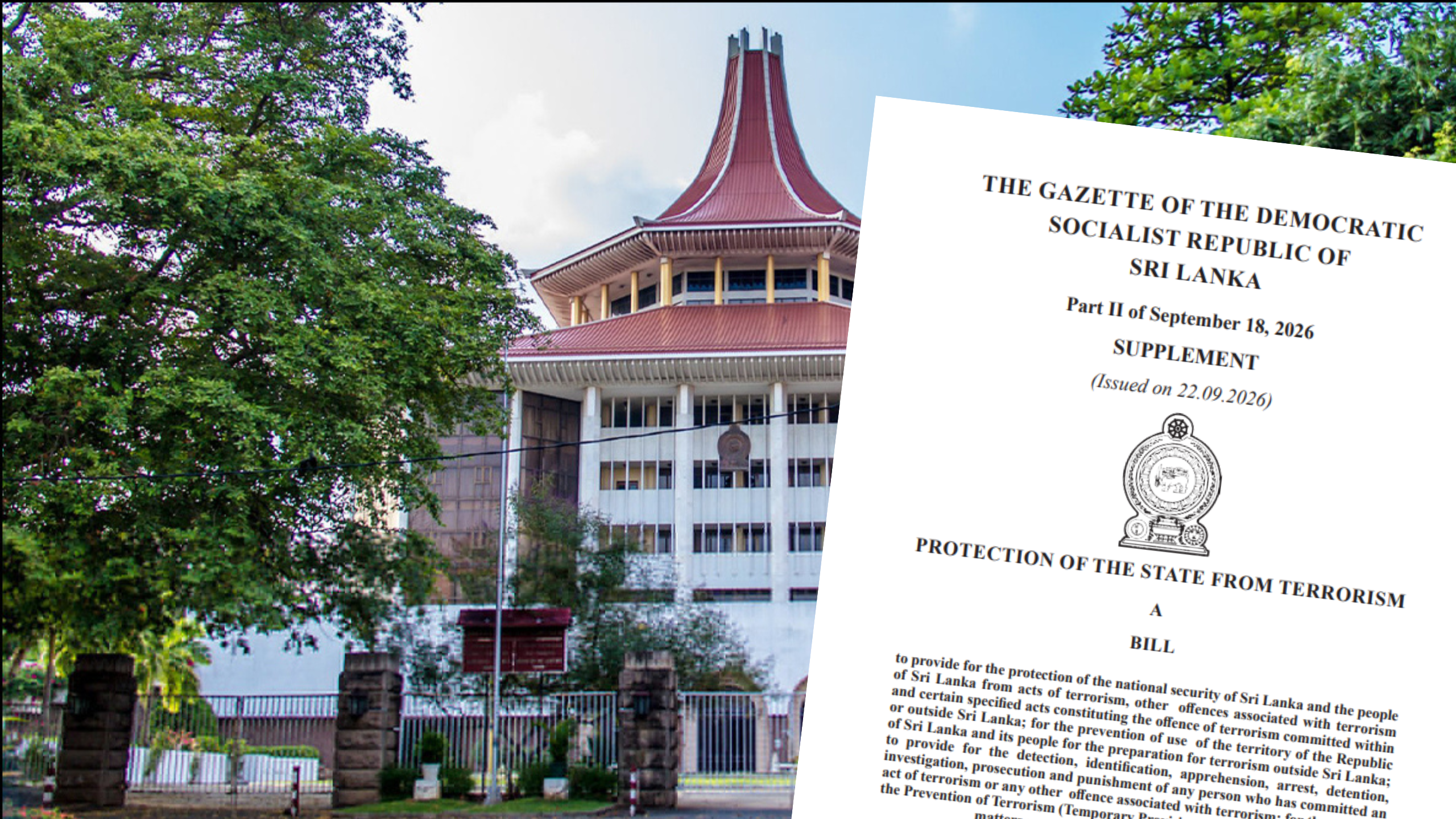
The Supreme Court began hearing 25 petitions on Tuesday (October 20) challenging the constitutionality of the government’s proposed Protection of the State from Terrorism Act (PSTA).
Counsel for petitioners, including journalists and former Prevention of Terrorism Act (PTA) detainees, told court the Bill would expand arrest and search powers and restrict judicial discretion, making it “far more dangerous” than the PTA, according to media reports of the arguments presented on Tuesday.
The government says the PSTA is intended to replace the 47-year-old PTA with a modern legal framework that addresses its shortcomings while protecting national security.
What is the PSTA?
The PSTA is a Bill gazetted on September 22, 2026, and intends to repeal and replace the PTA of 1979.
It seeks to create a new legal framework for the detection, arrest, detention, investigation and prosecution of terrorism-related offences.
The Bill was presented to Parliament on October 6 and is now before the Supreme Court as part of the constitutional review process ahead of its second and third readings in Parliament.
The PTA has long been criticised over prolonged detention, restricted fair-trial protections and allegations of torture or ill-treatment.
Justification
Cabinet approved publication of the Bill in August, with Justice and National Integration Minister Harshana Nanayakkara saying it had received Attorney General clearance.
Cabinet spokesperson and Health Minister Nalinda Jayatissa said the legislation was drafted to protect democratic freedoms and fundamental rights while also preventing terrorism and organised crime.
The government’s position is that Sri Lanka still needs a modern counter-terrorism framework, even as it moves to repeal the PTA.
Arguments
Petitioners argue that Clause 19 of the Bill would allow not only police officers but also armed forces and Coast Guard personnel to conduct searches and arrests, whereas the PTA requires an arrest by a police officer above the rank of Sub-Inspector, according to Daily Mirror reporting.
They also challenge Clause 37, saying it would prevent a Magistrate from discharging a suspect for insufficient evidence without the Attorney General’s consent, according to the same reporting.
Petitioners also argue that the Bill’s broad definition of terrorism, combined with powers to declare organisations and publications as terrorist entities, could be used against political dissent, journalism and peaceful protest rather than only serious violent acts.
Criticism
International and local human-rights groups have criticised the Bill, stating that its definition of terrorism remains too broad and that it lacks adequate judicial checks and balances.
Human Rights Watch says the Bill retains an overbroad definition of terrorism, inadequate judicial oversight, sweeping search-and-arrest powers for the armed forces, and executive authority affecting speech, assembly, association and movement.
The United Nations human rights office has said the Bill contains provisions that risk violating international human-rights obligations and could perpetuate abuses associated with the PTA.
Transparency International Sri Lanka has warned that the definition could cover property, environmental, cultural and electronic-system damage that should be dealt with under ordinary criminal law, potentially restricting legitimate civic activity.
The Free Media Movement has warned that the broad definition of terrorism could capture protests, rallies and political opposition, while weakening judicial supervision of arrests and detention.
What happens next
The Supreme Court is hearing the petitions and will determine whether the Bill, or specific clauses, are inconsistent with the Constitution.
If the Court finds that certain provisions require a two-thirds parliamentary majority and a referendum, the government would need to meet those thresholds before enactment.
The Bill can become law only after completing the constitutional review process and being passed by Parliament.













Comments
Moderated before publishing. Your email stays private.